Governments That Have Returned Stolen Ww 2 Art to Jewish Famlies
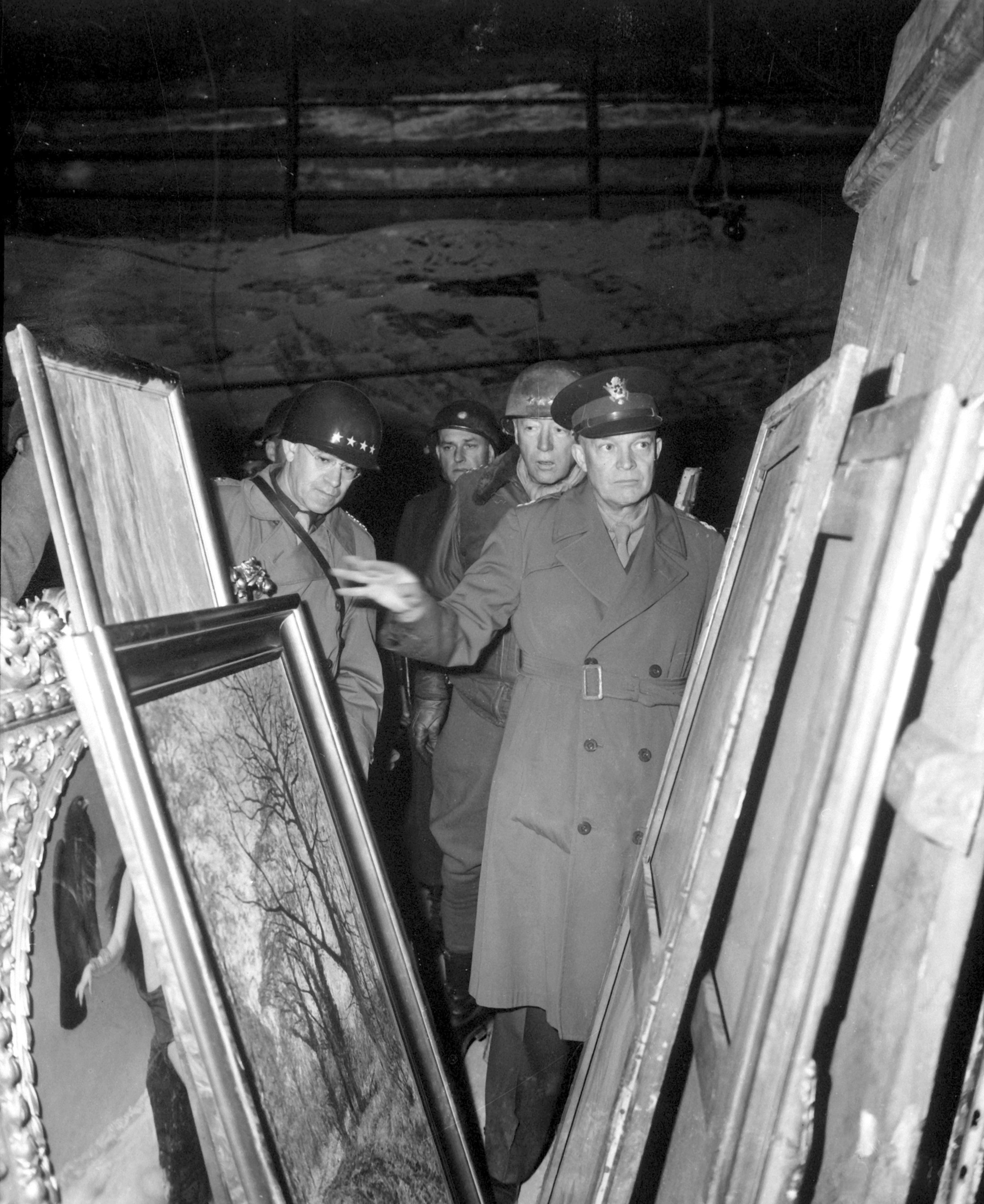
Dwight D. Eisenhower (correct) inspects stolen artwork in a salt mine in Merkers,
accompanied by Omar Bradley (left) and George Due south. Patton (center)
During World War 2, Nazi Germany led a systematic campaign to loot and plunder art from Jews and others in the occupied countries. Much of the stolen art was recovered past the Allies in the immediate backwash of the war, nonetheless, thousands of valuable art pieces were not returned to their rightful owners or were never relocated. In the decades following the Holocaust, a concerted international effort was undertaken to place Nazi plunder that however remains unaccounted for with the aim of ultimately returning the items to the rightful owners or their families.
The Tertiary Reich amassed hundreds of thousands of pieces of artwork - worth billions of dollars - and stored them throughout Germany. Other pieces deemed "degenerate" were legally banned from inbound Frg so Hermann Goering and Joseph Goebbels tasked a number of approved dealers with liquidating these avails overseas and passing the funds dorsum for the Nazi war effort.
At the stop of World State of war Two, the Allies found plundered artwork in more than one,000 repositories beyond Deutschland and Austria. Under the direction of the U.S. Army, nigh 700,000 pieces were identified and restituted to the countries from which they were taken, whose governments were so supposed to locate the original owners and return the art. Unfortunately, thousands of pieces either never made their way dorsum to the rightful owners or the owners could not be tracked down.
In 1985, European countries began to release inventory lists of works of art "that were confiscated from Jews by the Nazis during Earth War II, and announced the details of a procedure for returning the works to their owners and rightful heirs."
The recovery of stolen art took a more international scale in 1998. On June 30, thirty-9 countries signed a joint pledge to identify fine art stolen from Holocaust victims and to compensate their heirs. Nearly every European state - in addition to the Us, Canada, Argentine republic, Brazil, Russia and State of israel - signed the understanding. Before long afterward, an Austrian advisory panel recommended the return of half dozen,292 art objects to their legal owners, most of whom were Jews.
In November 1998, the U.Due south. Department of State and the U.S. Holocaust Memorial Museum co-hosted the Washington Briefing on Holocaust-Era Assets in whcih delegations from 40-iv governments and thirteen non-governmental organizations participated. Though the conference addressed various issues related to the confiscation of assets past the Nazis during the Holocaust, the chief issue was looted art and the conference achieved a substantial degree of consensus on a gear up of principles dealing with looted art. These principles include encouraging research into the provenance and identification of fine art, calling for these findings to be publicized, urging the institution of a cardinal computerized registry linking all Holocaust-era art-loss databases and encouraging alternative dispute-resolution strategies.
Post-obit the Washington Conference, the Association of Fine art Museum Directors developed guidelines requiring museums to review the provenance of their art collections, focusing on art looted by the Nazis. The National Gallery of Art in Washington, for example, identified more than 400 European paintings with gaps in their provenance during World War 2 era while New York Metropolis'due south Museum of Mod Fine art told Congress that they were "non aware of a single Nazi-tainted piece of work of fine art in our collection of more than 100,000."
In Frg, the government subsequently established the Lost Art Database to serve as a primal office for the documentation of lost cultural property which every bit a result of Nazi persecution were relocated, moved or seized, especially from Jewish owners.
In Jan 2006, a court ruling stated that Austria must return five paintings by globe renowned artist Gustav Klimt to the heirs of a Jewish family from whom the paintings were stolen during the Nazi occupation in Austria. The paintings had been housed and displayed for decades in the Dais castle gallery in Vienna.
In Nov 2013, German authorities appear the discovery of a trove of near ane,500 artworks confiscated by the Nazis. The fine art was unearthed about two years prior in a Munich flat belonging to the son of Hildebrand Gurlitt, one of Goering's specially approved fine art dealers commissioned to liquidate degenerate art, but was non announced at the time to allow for the building of a provenance investigation. The works, by artists including Picasso, Matisse and Chagall, are estimated to be worth about $1.35 billion, though determining their rightful could take years.
The Claims Conference on Jewish Material Claims Against Germany (the Claims Conference) and the Globe Jewish Restitution Organization (WJRO) appear on September 11, 2014, that at that place has been extremely minimal endeavor put forth by individual countries since The Washington Conference to render Jewish artwork stolen by the Nazis. The 2 organizations had been studying the identification of Jewish artwork and historical artifacts stolen by the Nazis for the past fifteen years and have come to the conclusion that the bulk (2/iii) of countries who had signed on to Jewish art reparration agreements take done "little or naught" to implement the requirements of these agreements. In order to ensure that all fine art makes its style dorsum to the rightful owners, every bit a function of the report the Claims Conference and the WJRO suggested that an "International Association of Provenance Researchers" be formed in order to assist museums in evaluating their collections and making sure that no stolen art is included. The implementation of this association will allow standards to exist created for stolen art evaluation, provide assistance and training for art professionals, and generally provide another artery for effective communication and cooperation between museum staff effectually the earth.
A partnership betwixt university researchers, the German Lost Art Foundation, and the descendants of Rudolf Mosse was announced in March 2017 in support of the Mosse Art Research Initiative. The project aimed to locate the expansive lost art collection of prominent publisher Rudolf Mosse, who fled to France in 1933 shortly after the Nazis ascent to power. Although this was the offset time that the German Lost Art Foundation had financed a plan to track down a particular family's heirlooms, a spokesperson for the Foundation stated that theyhope that more than projects of this variety volition apply for funding in the hereafter.
Eleven German museums and archives have agreed to participate in the Mosse Art Research Initiative. The initiative had been active for five years before the 2017 collaboration was announced, and several institutions housing stolen Mosse art have already been identified. Altogether, researchers believe that the Nazis looted approximately four,000 works from the Mosse collection.
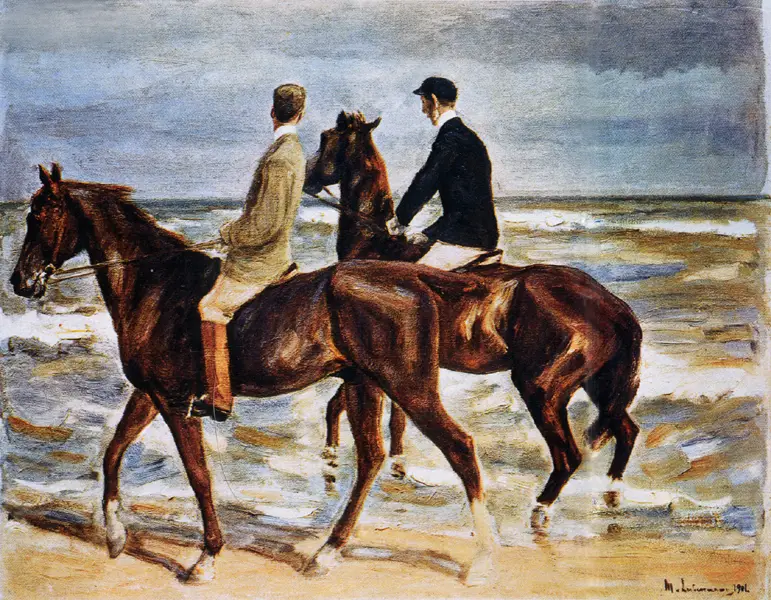
Max Liebermann's Two Riders On The Beach discovered in the Gurlitt Drove and afterward restituted to the descendants of the original Jewish owner
northward June 2018, a stolen sculpture discovered in the Bode Museum in Berlin, Germany was returned to the heirs of the original owners and then sold back to the museum. The sculpture, which depicts 3 angels floating on clouds surrounding a sleeping infant Jesus, had once belonged to German Jewish Industrialist Ernst Saulmann and his wife Agathe. The couple fled Germany in 1935 and their land, businesses and belongings were confiscated by the Nazis. The Saulmanns were captured by Nazis in France and were sent to internment camps. Although they survived the camps and were rescued, they both died shortly after the war. Descendants of the Saulmanns hired researchers to find their families stolen art, and take been able to notice eleven works out of the hundreds that were stolen.
In 2019, Berlin's Gemäldegalerie returned 2 panels dating from virtually 1455 by the Italian artist Giovanni di Paolo depicting two scenes of the life of St. Clare of Assisi to the heirs of Harry Fuld Sr. In past years the Fuld's received other possessions looted by the Nazis. Fuld, who died in 1932, owned a Frankfurt-based company that produced and sold telephones, which was expropriated from his wife and sons who later on fled the country.
In Jan 2020, the German government returned three works of art stolen during the Nazi occupation of French republic to descendants of their original owner, the collector and Jewish lawyer Armand Dorville who died in 1941. The three items were amid the roughly 1,500 discovered in the home of Cornelius Gurlitt in 2013. Gurlitt's male parent had been given the task of selling art taken from Jewish owners. Only xiii works have been returned to the families of the original owners.
Sources: Lost Art Net Database;
Wikipedia;
National Gallery of Art Provenance Enquiry;
Associated Press (June 30, 1998);
Washington Post (January eighteen, 2006);
Congressional Research Service of the Library of Congress for the U.S. House International Relations Committee;
The Claims Conference;
Colin Moynihan.German Foundation to Aid Jewish Heirs in Search for Nazi Looted Fine art
, New York Times (March 7, 2017);
Berlin Museum Returns Nazi-Looted Sculpture To Jewish Heirs,
JTA, (June 29, 2018);
Marcy Oster, "Nazi-looted fine art returned to heirs of German-Jewish art collector," JTA, (September iv, 2019);
"Frg returns artwork stolen by Nazis to French Jewish family," AFP, (Jan 22, 2020).
Photos: Eisenhower - Lt. Moore, U.S. Army, Public domain via Wikimedia Commons.
Max Liebermann, Public domain via Wikimedia Commons.
Source: https://www.jewishvirtuallibrary.org/recovering-stolen-art-from-the-holocaust
0 Response to "Governments That Have Returned Stolen Ww 2 Art to Jewish Famlies"
Post a Comment